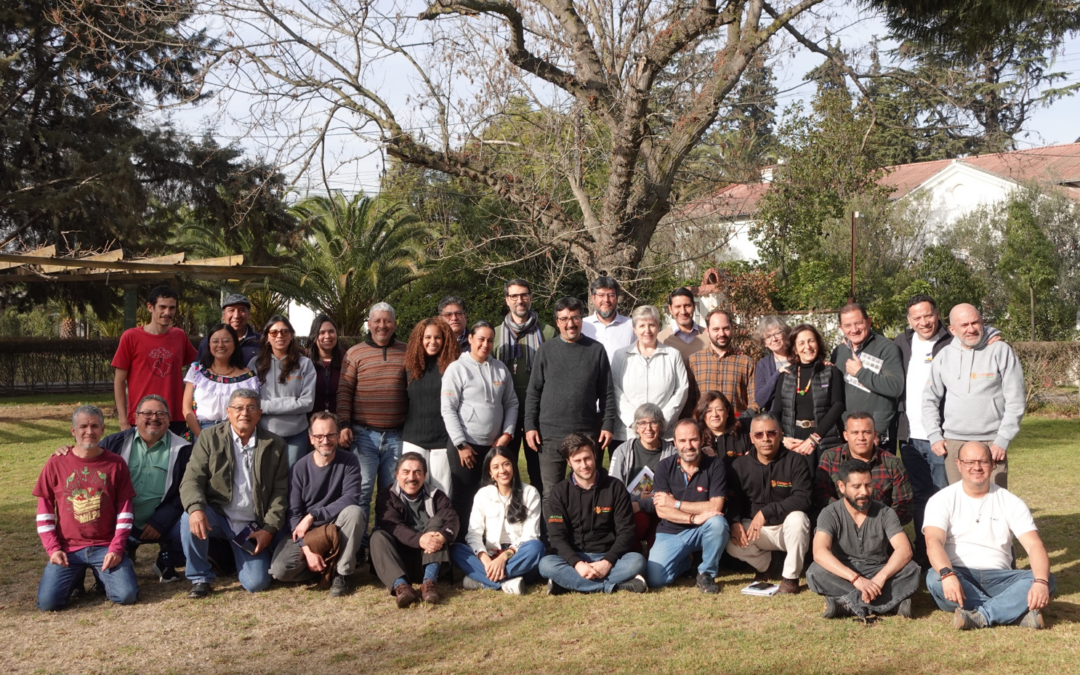
From July 10 to 12, Red Comparte held its in-person assembly in Santiago de Chile, at Casa de Ejercicios Loyola. The gathering brought together representatives from 16 of the Network’s social centers, its coordinating and technical teams, and professors from partner universities, for a day of context analysis, reflection and joint projection. The image of the Network as a caravan — each one moving at their own pace, but advancing in the same direction and making sure no one is left behind — accompanied the whole gathering.
The context session laid out the main challenges facing the economic initiatives accompanied by the social centers: the defense of territory against extractive pressure, care for our common home, violence and insecurity as a threat to local enterprises, gender equity, and the dialogue between ancestral knowledge and science. This was followed by the presentation of the interim monitoring of the Network’s Strategic Plan, which showed significant progress on several indicators while also identifying remaining challenges in commercialization, autonomy and financing of the initiatives.
Representatives from Deusto, ESADE, CIIESS and IQS shared their experience of accompaniment, agreeing that the relationship with the social centers must be mutually beneficial, going beyond the learning it offers students themselves.
A central part of the gathering was devoted to the Common Gender Framework, whose progress was shared and discussed in groups addressing its application at the personal, institutional and network-wide levels. The assembly closed with a forward-looking exercise, in which each participant shared their vision for the future of Red Comparte and the concrete commitment they take on to make it possible, shaping a true shared “vision cloud.”
The gathering was part of a broader week of work by CPAL’s Social Area in Chile, which also included the Assembly of the Network of Social Centers, and was marked by participation in the “Night of Encounter” activity, alongside the Juntos en la Calle project, which works with people living on the streets of Santiago — a reminder, for those who are part of Comparte, of why it is necessary to keep building another kind of economy.