

From August 26 to 29 in Zug, Switzerland, the 3rd biennial conference “Environmental Justice: Making Hope Possible” (Environmental Justice: Making Hope Possible) was held. With around 50 participants representing universities, foundations, companies, networks, and Indigenous communities from more than 20 countries across Africa, Asia, the Americas (North, Central, and South), and Europe, the main themes focused on transdisciplinarity and socio-ecological transformations through keynote conferences, parallel sessions, cultural spaces, and deep reflection.
The Comparte Network was represented by our colleagues Mayra Leiva, Diana Giraldo, and Alberto Irezabal. Mayra represented the K’iche Indigenous community of Quetzaltenango (Guatemala) and the social center SERJUS, a member of the Comparte Network, highlighting the tenacity and resilience of her community, especially the contributions of women in defending their culture and land against a patriarchal economic system that prioritizes “the benefit of the few” over “the poverty of the many,” which harms their livelihoods and degrades natural ecosystems. Alberto Irezabal participated in the assembly’s preparation as part of the conference’s academic and organizational committee, representing the Comparte Network and the International Center for Research in Social and Solidarity Economy at the Universidad Iberoamericana of Mexico City.
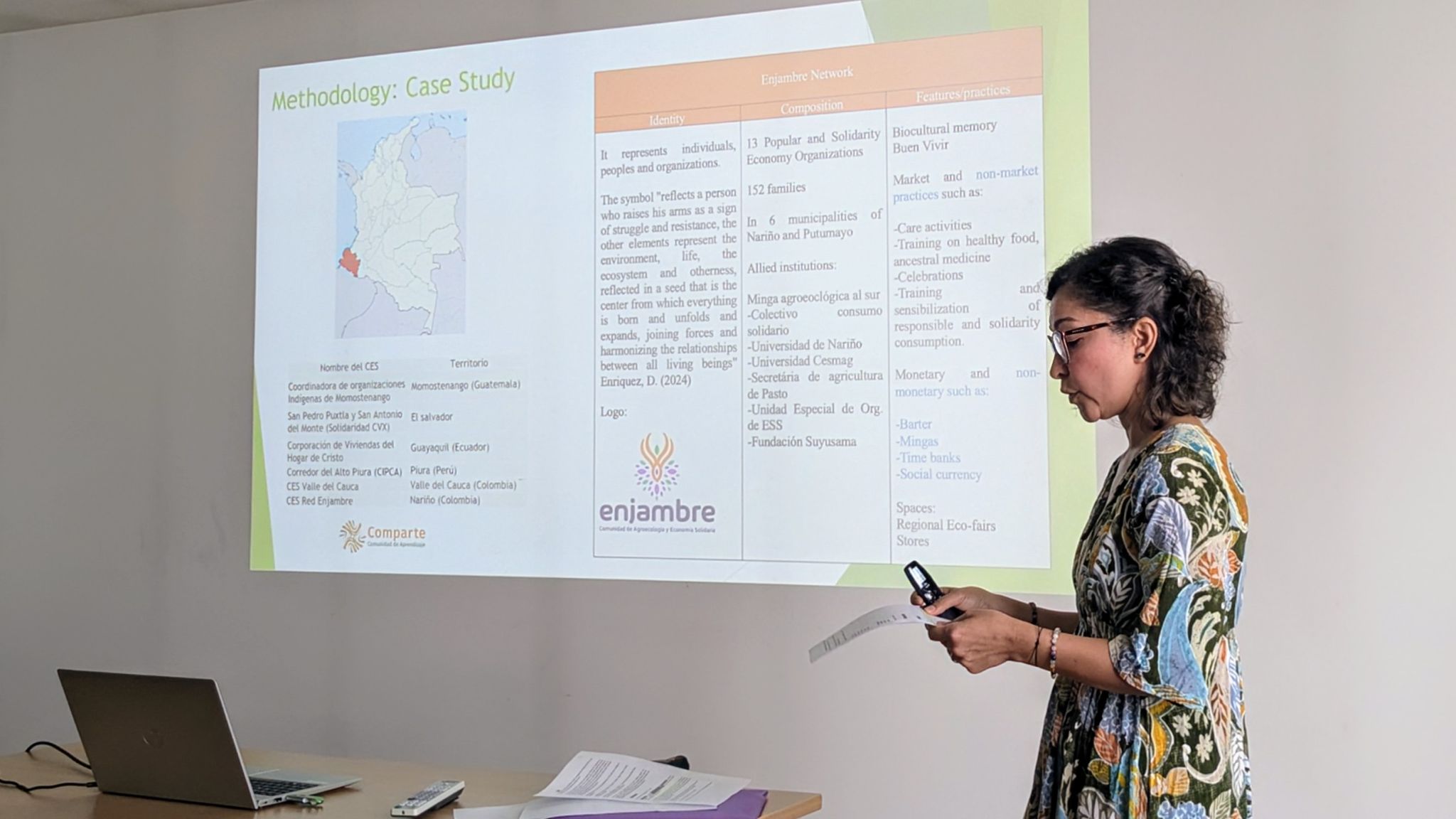
Meanwhile, Diana Giraldo, a doctoral candidate at the University of Lisbon and a Comparte collaborator, presented the Comparte Network’s Methodological Pathway and how it has facilitated the development and scaling of various economic-productive initiatives. She highlighted the inter-cooperation between Capeltic (Mexico) and Garittea (Colombia) coffee shops within the coffee value chain through experience-sharing, farmer-to-farmer learning, a multi-stakeholder approach, social business plans, among other methodologies and tools co-created by the Comparte community. Diana also shared her doctoral research project, which focuses on Solidarity Economic Circuits with a case study on the Enjambre Network in Nariño (Colombia).
Through this participation, we continue to showcase the work of the Comparte Network across various spaces, demonstrating how it fosters hope in affected areas of Latin America amidst multiple crises, based on the premise that inequality, poverty, and injustice suffered by marginalized populations cannot be reduced without simultaneously working towards ecological transformation and gender equity. It further affirms that enduring hope can emerge from collective experiences, where support processes lead to actions that materialize the transition from theological hope to transformative practice, fostering a virtuous cycle of hope.
Written by:
Diana Patricia Giraldo G.
Doctoral Candidate, University of Lisbon, and Collaborator, Comparte Network.