

In the heart of Santa Cruz del Quiché, Guatemala, an event took place that was full of learning, exchange, and commitment to agroecology. The KANO’J Association, together with its agroecological center, hosted the first module of the Regional School of Agroecology—an initiative that brought together representatives from 13 community organizations that are advancing agroecological transition processes and SPG participatory certification.
Over four days, 25 women and 10 men producers from different communities shared experiences, reflected collectively, and practiced tools that strengthen the path toward agroecological systems that are fairer, more sustainable, and recognized by their own communities.
Strengthening Capacities through Local Experience
The main goal of this first module was to reinforce the work of local SPG commissions, which accompany participatory certification processes in their territories. To achieve this, methodologies developed through practical experience by ASERJUS—a member organization of the Red Comparte network—were used, including:
- Plot characterization or “X-ray”
- Current layout and envisioned design of the plot over a 10-year horizon
- Agroecological improvement plan
The TAPE tool, developed by the FAO, was also applied. It allows the evaluation of agroecological performance across multiple dimensions of sustainability.
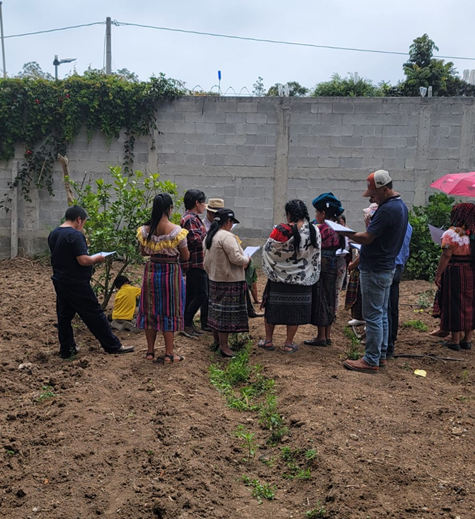
Fieldwork during the diagnostic phase and in-field recommendations, Chajbal, Santa Cruz del Quiché, El Quiché, May 27, 2025.
KANO’J: A Territory of Practice and Dialogue
KANO’J made its plots—currently undergoing certification—available to participants for practical exercises using the tools, allowing feedback from the experiences of other territories such as Quetzaltenango and Totonicapán. One outcome of the meeting was the identification of the need to strengthen local SPG cores, as they are the heart of the process. The recommendations emerged in an atmosphere of respect and collaboration and were even expressed through drawings and maps made by the participants themselves.

Presentation of technical recommendations for systems in agroecological transition, Group 2, Regional School of Agroecology, Santa Cruz del Quiché, May 27, 2025.
Guided by indicators agreed upon by the SPG Working Group of the Red Comparte network—which include social, environmental, technical, and spiritual dimensions—the group’s reflections went beyond the technical. There was a special emphasis on the social and gender dimension, recognizing the barriers women face to fully participating in these spaces due to the burden of domestic work. Particularly valuable was the self-critique from the male participants, who committed to sharing these responsibilities to ensure that the agroecological process is truly equitable.
Challenges and Commitments from the Territories
Among the main challenges identified to strengthen the SPG in communities were:
- Ensuring equitable participation between men and women (50/50) in local commissions
- Promoting leadership rotation, favoring those who have already certified their plots
- Involving new actors in the process: consumers, other NGOs, churches, municipal governments, and the health sector

The module concluded with a collective commitment: to continue participating voluntarily in this path of transformation, with the understanding that agroecology is not just a way of producing, but a way of living in harmony with the Earth and with each other. Having the support of the SPG COMPARTE seal gives them confidence and visibility—both within and beyond Guatemala.
