

From April 21 to 23, the CEPAG – Antonio Guasch Paraguayan Studies Center hosted the in-person meeting of the Working Group of the Participatory Guarantee System (PGS) of Comparte, an initiative that strengthens agroecological transition processes promoted by social centers of the network. Eight representatives from seven social centers that develop PGS in their territories participated: ASERJUS, ACLO, SCVX, Suyusama, CIPCA Peru, and CEPAG, as well as Claudia Ruiz, the executive secretary of the network.
The three main themes of the meeting were sustainability, articulation, and training. The program emphasized working from practice, learning from field experiences that demonstrate how PGS are alive in the territories, led by peasant and indigenous men and women committed to the common good, community organization, and the defense of the common home.
Inspiring Experiences from the Territory
During the event, several experiences were visited:
-
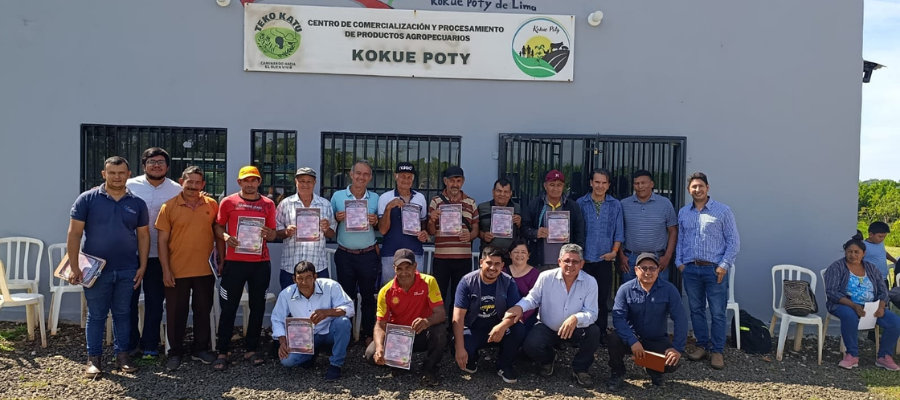
The Kokue Poty Market Association of Lima (AFEKOPOL), composed of 7 women and 12 male producers.
-
The plot of Mr. Aquiles Fernández, supervisor of the PGS promoted by CEPAG.
-
The farm of Arsenio Martínez and Angélica Duarte, a model of family production.
-
The farm of Marino Cañete, a producer and teacher committed to agroecological practices.
-
The Teko Katu store, a direct marketing initiative managed by CEPAG.
-
The Organic Producers Association (APRO), a key ally of CEPAG in the consolidation of PGS.
These visits allowed participants to observe how agroecology is lived daily and how women play a central role as leaders in cooperatives, stores, organizational spaces, and training processes.
Reflection, Articulation, and Shared Learnings
In a second phase of the meeting, there was a deeper collective analysis on the integral sustainability of agroecological transition processes. The importance of making training, participatory governance, gender approach, and spirituality transversal pillars in the PGS was highlighted. Additionally, advancements in the governance structure, the strategic role of Agroecology and PGS Schools, and the need to maintain a comprehensive vision that harmonizes the technical, organizational, formative, and human aspects were shared.
Challenges and Commitments for 2026-2027
The meeting concluded with the development of a 2026–2027 Work Plan, reinforcing the collective commitment to continue walking together. The main challenges identified were:
-
Strengthening the autonomous governance of PGS.
-
Improving monitoring and evaluation based on technical indicators.
-
Promoting research and systematization processes.
-
Ensuring the integral sustainability of the systems.
-
Actively including consumers as essential actors in Intercultural Solidarity Economic Circuits.
These learnings were reflected in the testimonies of participants, such as Cosme Rigoberto from SCVX (El Salvador) and Marcos Gómez from Suyusama (Colombia), who shared their impressions of the value of the meeting:
A Meeting Full of Flavor, Culture, and Hope
Beyond the technical and organizational exchange, this space was also a celebration of the flavor, color, and culture of the peoples. A moment to strengthen bonds of brotherhood, renew the commitment to socio-environmental transformation, and reaffirm that another world is possible when walking in community, from equity and justice.