

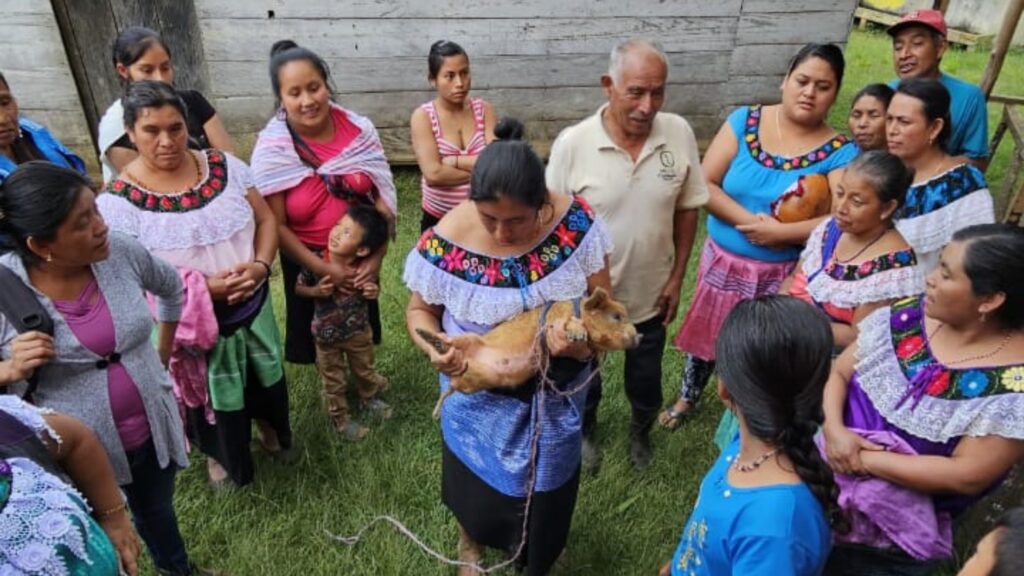
In Chiapas, 80 Tseltal women from 10 communities are leading a powerful transformation: they are taking control of their family and community economies through a productive credit model based on in-kind loans with native piglets, combined with financial education. This initiative, driven by the cooperative group Yomol A’tel — part of the Comparte network — has grown rapidly since its start in 2022, when it began with just 12 women. Its community acceptance and tangible impact have enabled it to scale easily across the region, bringing together production, organization, and finance with a female face.
Community Promoters: Key Pillars of the Process
A key pillar in this process has been the work of Tseltal women like María Candelaria Rodríguez Hernández, a community promoter who coordinates financial education activities, monitors agreements, strengthens the participation of fellow women, and brings more women into the project. Her close and continuous involvement has been essential in keeping community organization and collective learning alive.
A Solidarity System That Welcomes More Women Each Year
Each woman receives two piglets as part of an in-kind microcredit system, with the commitment to return at least two offspring once the animals reproduce. This allows new women to join the process, creating a self-sustaining and solidarity-based system. But the project goes beyond just distributing animals: it includes a robust training program on topics such as investment, reinvestment, cost calculation, savings, and household financial management — all conducted in the women’s native language.
As part of this pedagogical and cultural approach, four bilingual manuals (Spanish-Tseltal) have been developed based on the women’s own experiences. These materials are used in in-person workshops that are replicated in each community and complemented with ongoing support from the organization.
A Process That Integrates Production, Finance, and Gender Justice from Within Tseltal Territory
The impact has been remarkable: the women not only generate their own income through family consumption savings or the sale of piglets, but they also actively participate in assemblies, make decisions, and strengthen local organization through community agreements on credit management. In many cases, they have begun using animal waste to make compost and improve their gardens, adding agroecological practices to the initiative.
This model, deeply rooted in culture and territory, shows that economic autonomy, gender justice, and sustainability can be built from the ground up — with collective wisdom, community organization, and a pair of piglets as a starting point.