
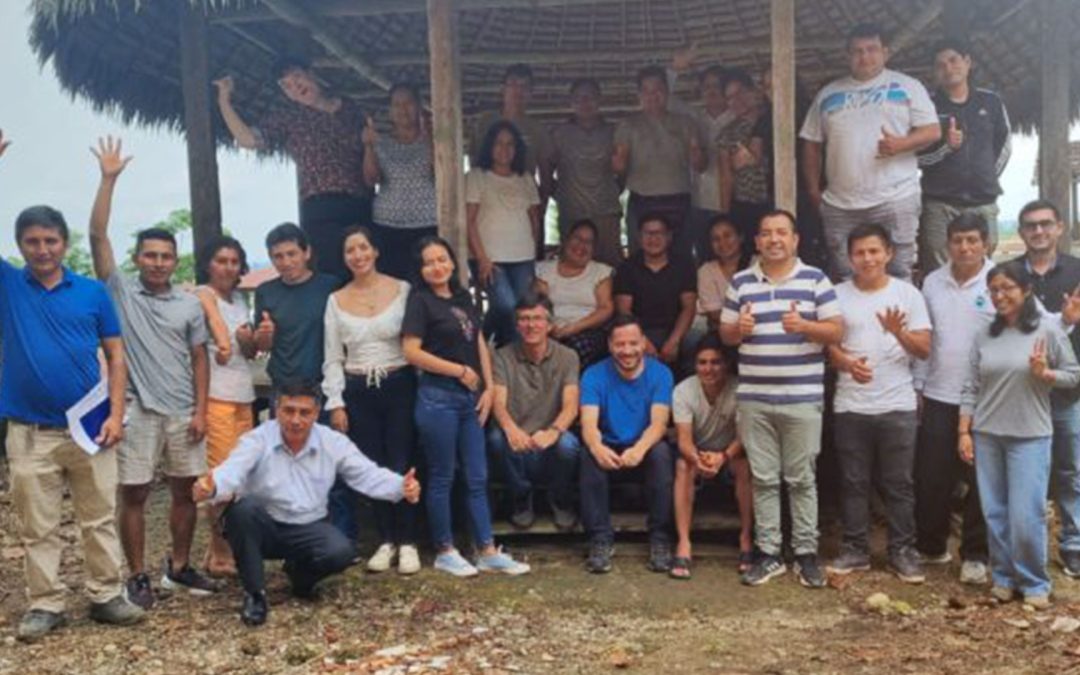
An enriching educational program is gaining momentum in the Condorcanqui and Quispicanchi regions of Peru, promoting sustainable development through circular economy practices. Led by the Comparte network, INEA (School of Agricultural Engineering at Comillas University), and Universidad Antonio Ruiz de Montoya, with support from Entreculturas, Fe y Alegría, CCAIJO, SAIPE and the AVSI Foundation, the program aims to equip local authorities, public servants, social organizations, and key institutional representatives with innovative strategies for sustainable development.
The primary goal is to provide participants with the skills needed to design and implement strategies based on circular economy principles, thus enhancing the economic, social, and environmental vitality of rural enterprises in these regions.
Supported by Universidad Antonio Ruiz de Montoya in Peru and INEA of Pontifical Comillas University in Spain, the program offers a 150-hour diploma course. Participants engage in in-person workshops, live virtual sessions, recorded lectures, and practical exercises, all designed to maximize learning and the practical application of concepts.
Targeted at authorities and officials from the Quispicanchi and Condorcanqui district municipalities, as well as public and private sector representatives linked to agricultural and tourism activities, the program commenced on April 3 and is set to conclude in early September. In April, two on-site workshops were held in each region, focusing on the conceptual and methodological framework of alternative and solidarity economies, led by Comparte network members Álvaro Idarraga (Comparte Executive Secretariat) and Luis Javier Rodríguez (Suyusama Foundation).
With around 50 participants from various sectors representing a broad spectrum of local organizations and institutions, the workshops were met with great interest and commitment. Practical implementation of the shared knowledge will be facilitated by local steering committees responsible for establishing work plans based on the ideas and strategies discussed in the sessions.
The program has also highlighted the alignment of initiatives, projects, and territorial agendas, fostering a coordinated approach to circular economy processes. The considerable potential of these regions to adopt and promote sustainable practices has been emphasized, with invaluable support from the Jesuit Social Centers present in the area (CCAIJO and SAIPE), who are committed to actively collaborating on these initiatives.
With this educational and collaborative drive, it is hoped that these communities will continue to move toward a more sustainable and resilient future, integrating circular economy principles into their development strategies. An essential step toward a more sustainable and prosperous tomorrow for everyone!
This project is part of the broader initiative “Circular Economy for Greater Economic, Social, and Environmental Profitability of Rural Enterprises,” led by Entreculturas in partnership with CCAIJO, SAIPE, Fe y Alegría, and the AVSI Foundation, and funded by the Spanish Agency for International Development Cooperation (AECID).
Red Comparte
With information from desarrollo-alternativo.org