
Comparte Network, in partnership with Alboan, participated in the Basque Circular Summit 2025, held in Bilbao from April 2 to 4, one of Europe’s most important events on circular economy. The aim of the event was to promote the transition to a more sustainable economic model, one that is efficient in resource use and low in carbon emissions, by bringing together public, private, and civil society actors to share innovative solutions to the climate crisis and social challenges.
In this context, Comparte network presented two emblematic experiences that reflect its commitment to an economy that serves life and the care of the Common Home.
Tejedoras de Sueños: Empowerment and Textile Recycling
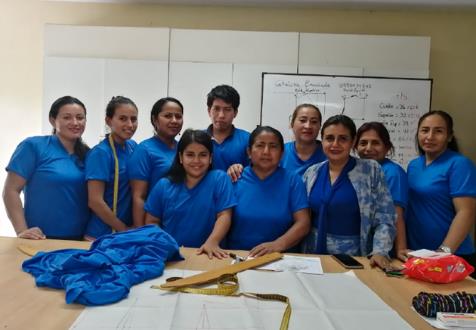
The first was Tejedoras de Sueños, a textile recycling initiative led by women in Guayaquil, Ecuador. This project combines environmental sustainability, women’s empowerment, solidarity economy, and recycling to give new life to textile materials, primarily denim, which would otherwise become waste. They create value-added products such as backpacks, bags, and wallets, which are marketed both locally and internationally.
Internationally, the partnership has established a successful business relationship with the Austrian company Redwave, specializing in industrial recycling, to whom they sold 300 recycled material backpacks during the 2024 Christmas season. This business alliance demonstrates how collaboration within networks like Comparte promotes fair trade and relationships that benefit all parties involved.
Tejedoras de Sueños is an association that emerged within the “Entrepreneurship Seedbed” program, promoted by Hogar de Cristo, which is part of the Comparte network.
The Agroecological Farm of Villa Loyola
The second experience presented was the agroecological farm of Villa Loyola in Nariño, Colombia. On this 43-hectare farm, circular economy principles are applied by integrating environmental regeneration with agricultural production. The farm features a demonstration garden that teaches agroecological practices, growing products like coffee, fruit trees, guadua (bamboo), and promoting multipurpose livestock farming. Agrochemicals are eliminated, and organic waste is reused to create compost, thus closing the production cycle sustainably.
Additionally, the Suyusama Foundation, part of Comparte network, offers agroecological training to youth and farming families in the Nariño region, who then replicate these practices on their family and cooperative farms.
Café Capeltic – Our Coffee
Comparte network also highlighted its work in building fair and sustainable economic alternatives at the demonstration stand that Alboan, a member of the network, had at the event. Other transformative initiatives of the network, such as the Yomol A´Tel cooperative group and their Capeltic coffee, were also showcased, with attendees able to taste the coffee and learn more about Comparte’s work.
A Transformative Circular Economy
Comparte network offers a reading of the circular economy that, in addition to the environmental dimension, incorporates other fundamental dimensions (social, cultural, gender equity) to make it a real driver of social transformation.
Comparte’s participation in the Summit allowed for networking and highlighting Latin American proposals that, from the territories of 11 countries, are building fair and sustainable economic alternatives.